 Jetway
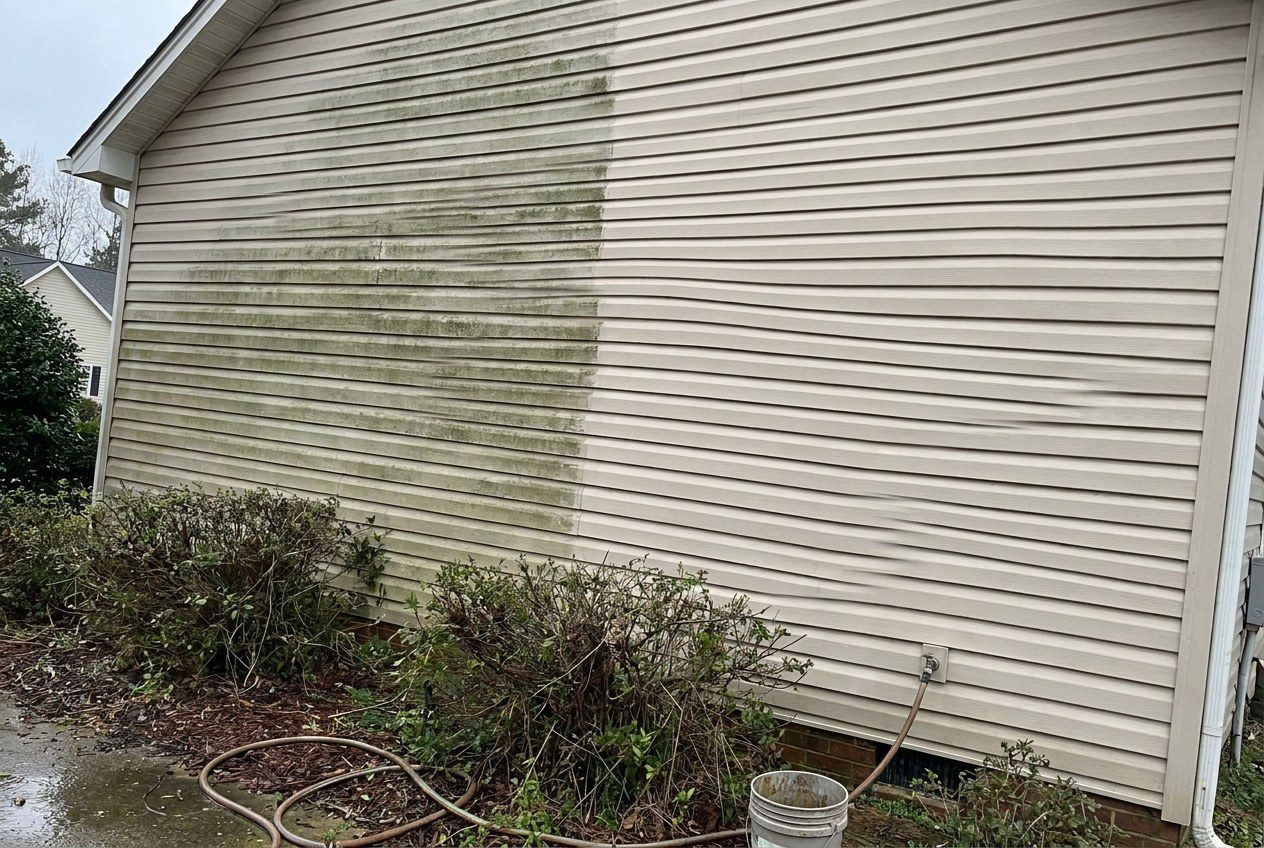
If you've noticed dark streaks running down your siding after a hard rain, roof algae washing onto siding this fall in Fayetteville, NC is likely the cause, not general grime, and not normal aging. It is Gloeocapsa magma, a cyanobacteria that colonizes asphalt shingles throughout the Southeast. Every time rain hits the roof, it loosens spores and cellular debris and carries them downward. That runoff has to go somewhere, and it goes straight down your siding, drips off your soffit, and fans out across your driveway or walkway concrete.
This happens all year, but fall rain events in the Fayetteville area make it worse. The region gets meaningful rainfall through September and October, often in heavy bursts after a dry stretch. That cycle, dry, then sudden heavy rain, is exactly the kind of event that dislodges algae in bulk. By the time November arrives, many homes in Hope Mills, NC have a fresh layer of biological material sitting on surfaces that homeowners assume are clean.
- Fall rain in the Fayetteville and Hope Mills area does not just clean your roof, it moves algae, spores, and dark streaks downward onto siding, fascia, and concrete.
- Gloeocapsa magma, the most common roof algae in the Southeast, travels in runoff water and can establish new growth on any porous surface it reaches.
- Cleaning only one surface while ignoring the others is a short-term fix, the algae returns faster because a nearby colony is still feeding it.
- Soft washing is the appropriate method for rooflines and siding; high-pressure rinsing works better for concrete flatwork where the surface can handle it.
- Early fall is the right time to act, before winter moisture locks new algae growth into your surfaces through the cold months.
#How Does Roof Algae Actually Travel Down to Siding and Concrete?
Roof algae spreads downward through simple hydrology, water runs downhill, and it carries whatever is on the surface with it. The streaks you see on shingles are colonies of Gloeocapsa magma that have built up a dark protective sheath. When rain disturbs those colonies, it breaks off spores and fragments of the organism. Those particles are suspended in runoff water and travel the same path water does: down the pitch of the roof, into the gutters, over the gutter lip if they overflow, or through downspout splash zones onto concrete at grade level.
Siding catches a lot of this. Vertical surfaces might seem like they would resist algae, the water runs off quickly, after all, but the microscopic texture of vinyl, wood, or fiber cement siding gives spores enough to grip. Algae does not need a puddle. It needs a surface that stays damp for even a few hours, which siding absolutely does in fall humidity. According to the NC State Extension, the humid climate conditions across the Carolinas create ideal circumstances for algae, mold, and mildew to establish on exterior building materials.
If your gutters overflow even slightly during a hard rain, the splash pattern on your siding and walkway is a direct delivery system for whatever is living on your roof. Cleaning gutters before fall rains helps slow the transfer, but does not stop it, and our fence and gutter cleaning service is worth scheduling before the heaviest fall rains arrive.
#What Does Transferred Algae Look Like on Siding and Concrete?
On siding, it usually shows up as a gray-green or dark greenish film, often heavier near the roofline and fading as you move down the wall. It can look like general grime at first glance, and many homeowners assume it came from the ground up rather than the roof down. Look closely at where it is thickest. If the heaviest concentration is near the top of the siding and gets lighter toward the bottom, roof runoff is the source.
On concrete, it tends to look like black or dark green staining in areas directly below downspouts or below roof overhangs. The concrete around a splash block is a common spot, as is the edge of a driveway where a downspout terminates. In some cases it blends in with normal concrete aging and goes unnoticed until the surface gets wet, algae-stained concrete turns noticeably slick when it rains, which is a safety problem beyond appearance.
#Why Cleaning Just One Surface Does Not Solve the Problem
This is the part most people miss. A homeowner pressure washes their driveway in October, it looks great, and then by spring the staining is back worse than before. What happened? The roof was never treated. The siding was never treated. Every rain event after that driveway cleaning re-seeded the concrete with the same spores still living comfortably ten feet above it.
Multi-surface cleaning matters because algae is a living organism with a source colony. If that source stays intact on the roof, the downstream surfaces will keep getting reinfected. The correct approach is to work top-down, address the roof first, then the siding, then the concrete. That sequence also makes practical sense because runoff from a higher surface treatment will fall onto lower surfaces you have not cleaned yet, not onto work you have already completed.
| Approach | What Gets Treated | Algae Reinfection Risk | Best Use Case |
|---|---|---|---|
| Single surface only (e.g., driveway) | One surface cleaned in isolation | High, source colony on roof remains active | Spot issue with no visible roof or siding growth |
| Multi-surface, top-down sequence | Roof, siding, and concrete addressed in order | Low, source removed before downstream surfaces cleaned | Visible streaking on roof and at least one other surface |
#What Cleaning Methods Work for Each Surface?
Soft washing is the right call for roofs and siding. It uses lower pressure combined with a cleaning solution, typically a diluted sodium hypochlorite mix, that kills the algae at the biological level rather than just blasting it off mechanically. High-pressure washing on shingles can strip granules and shorten roof life considerably. Siding, depending on the material, can also be damaged by direct high-pressure spray. The Asphalt Roofing Manufacturers Association specifically recommends low-pressure washing methods for algae removal to avoid granule loss and voided warranties. Our roof cleaning service uses soft washing precisely because it protects the shingle surface while eliminating the organism at its source.
Concrete is different. Flatwork is dense and durable, and it benefits from the mechanical action of a pressure washer running at appropriate PSI. A surface cleaner attachment, a spinning bar that keeps the spray even, prevents the zebra-stripe marks that come from moving a wand across concrete by hand. For algae-stained concrete, a pre-treatment