 Jetway
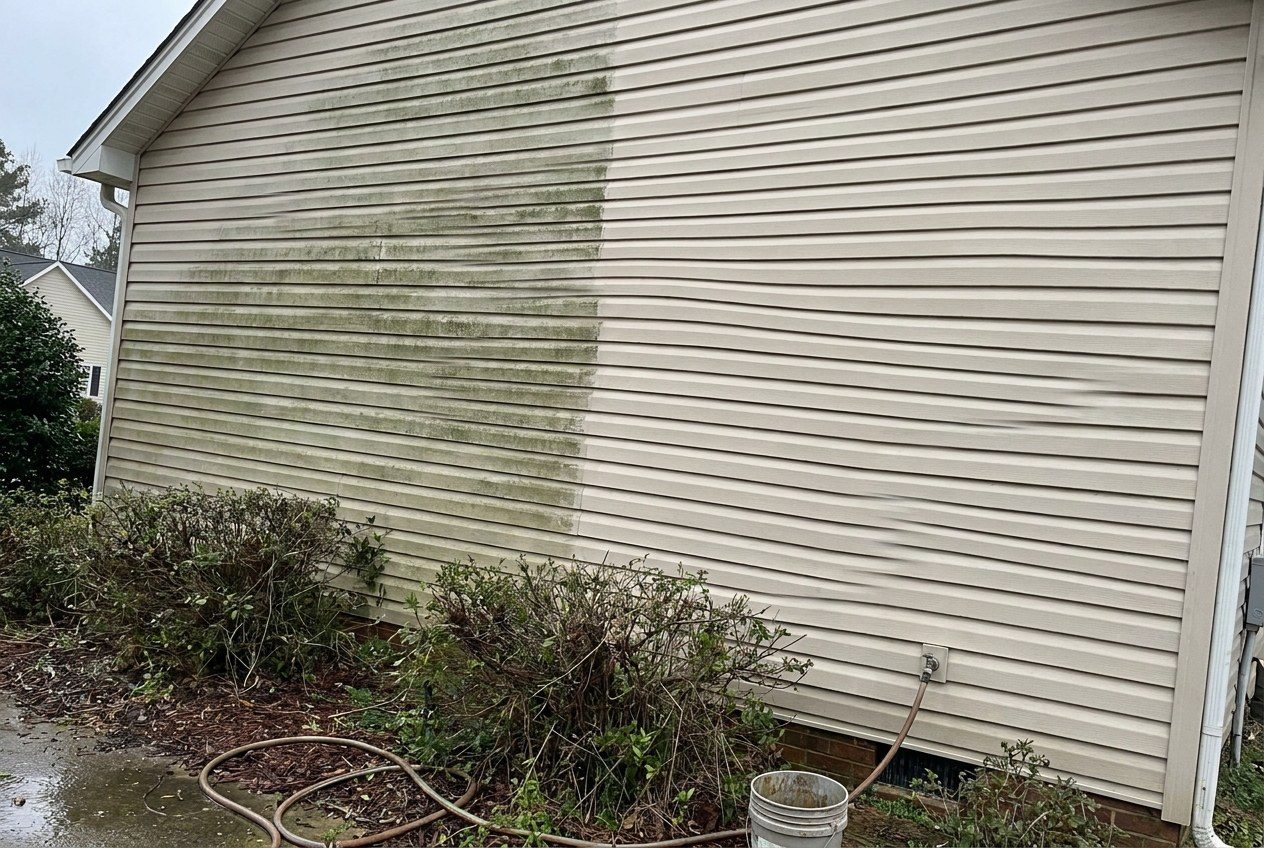
Black algae streaks on concrete block walls are one of the most stubborn exterior cleaning problems facing Cumberland County homeowners, and fall is precisely the wrong season to postpone treatment. You have probably noticed the signs: dark green-black lines running down the face of a concrete block wall, usually starting near the top or along a mortar joint, then spreading downward in a pattern that looks like someone dragged a dirty mop across the surface. It is easy to chalk it up to general grime and tell yourself you will deal with it in the spring. That is exactly what black algae is counting on.
Fall in Cumberland County is when black algae quietly consolidates its hold on exterior masonry. Morning dew, cooling overnight temperatures, and the wet leaf debris that piles against foundations all push moisture into block wall surfaces for hours at a stretch. Algae does not need sun to grow. It needs damp. And fall gives it damp in abundance.
If you are in Hope Mills, NC and you have a concrete block retaining wall, foundation wall, or garden border that has developed those characteristic dark streaks, the time to address it is now, before winter locks dormant spores deeper into the surface and turns a manageable cleaning job into a much harder one come March.
#How Does Black Algae Actually Attach to Concrete Block?
Black algae anchors itself to porous masonry using structures called holdfasts, a root-like grip that physically penetrates the surface rather than just sitting on top of it. This is the key difference between black algae and the softer green or gray mold you might also find on exterior walls. Mold sits relatively near the surface. Black algae goes in.
Concrete block is especially vulnerable because of its texture and porosity. The aggregate surface is rough enough to give spores plenty of purchase, and the block itself is porous enough that moisture wicks inward, pulling algae cells along with it. Mortar joints are even more porous than the block face, so streaks often start there and spread outward.
Black algae streaks often have a slightly raised, slick feel when you run your hand across them. They do not wipe off easily with a rag. If you scrub a spot with a stiff brush and it comes right off, it is probably surface mold. If the dark staining remains underneath, you are dealing with algae that has rooted into the block.
Black algae, often Gloeocapsa magma or related cyanobacteria, produces a dark, UV-protective pigment as a defense mechanism. That pigment is part of what makes it so visually distinct and so resistant to simple rinsing. The U.S. Environmental Protection Agency's guidance on biological growth on building materials confirms that surface rinsing alone is insufficient to eliminate organisms with established root structures in porous substrates.
#Why Does Fall Make Black Algae Streaks Spread Faster in Cumberland County?
Fall accelerates black algae spread because it delivers the two things algae needs most: persistent moisture and reduced UV exposure. Summer sun actually suppresses some surface algae growth by drying walls out quickly between rain events. Once September and October arrive in North Carolina, that dynamic flips.
- Morning dew keeps block wall surfaces wet for four to six hours most fall days.
- Overhanging trees drop leaves that mat against walls and act as a moisture sponge.
- Shorter days mean the sun has less time to dry the surface before dew forms again that evening.
- Rain events are often slower and steadier in fall, allowing more water to absorb into block rather than run off quickly.
The algae that was barely visible in August becomes a heavy, streaking colony by November. Once temperatures drop into the low 40s and below, the algae goes semi-dormant but does not die. It survives winter inside the surface and re-activates aggressively in spring. Cleaning in fall interrupts that cycle. This is the same reason our house washing service in Fayetteville, NC prioritizes fall scheduling for clients with heavy tree coverage, the treatment window is real and finite.
#What Cleaning Approach Actually Works on Block Walls?
Two steps are required, in order. Pre-treatment first, pressure washing second. Either one alone will not get the job done fully.
| Approach | What It Does | Limitation |
|---|---|---|
| Pressure washing alone (no pre-treatment) | Removes surface debris and loose biological growth | Does not kill holdfasts; streaks return within a few months |
| Chemical pre-treatment alone (no pressure washing) | Kills algae cells and breaks down the pigment layer | Dead material and staining remain on the surface without mechanical removal |
| Pre-treatment followed by pressure washing | Kills the root structure, then physically extracts dead material from the block pores | Requires more time and equipment; not a quick rinse job |
For pre-treatment, a sodium hypochlorite-based solution applied with a low-pressure soft wash system or a garden sprayer is the standard approach. The chemical needs dwell time, typically ten to twenty minutes depending on the concentration and the severity of the growth, before any pressure washing begins. Do not let it dry on the surface. If it starts to dry, mist the wall lightly with water to keep it active.
Concrete block is more fragile than poured concrete or natural stone. Working pressure should generally stay lower than what you would use on a driveway or sidewalk. High pressure aimed directly into mortar joints can dislodge or erode the mortar, which creates a whole separate repair problem. A wider fan tip and longer working distance protect the surface while still doing the job.
After the dwell period, rinse the pre-treatment off from the top of the wall downward. Then apply pressure washing in overlapping passes, again working from top to bottom so you are always pushing loose material down and off the surface rather than across or upward into clean areas. The same two-step logic applies when we handle driveway and concrete cleaning, pre-treatment before pressure, always.
#Can You Remove Black Algae Streaks With a Garden Hose or DIY Scrubbing?
A garden hose will not generate enough pressure to extract algae from block pores. Scrubbing by hand can remove surface material but leaves the holdfast structure intact, which means regrowth happens quickly, often within six to eight weeks. It is not that scrubbing accomplishes nothing; it is that it does not accomplish enough to make the effort worthwhile on a wall that is heavily colonized.
If the streaks are light and you caught them early, a stiff brush with a diluted bleach solution and a thorough rinse can manage the problem on a small section. Once the staining has spread across most of the wall face and the dark color is deeply embedded in the block, that approach becomes impractical and incomplete.
#What Should You Do to Protect the Wall After Cleaning?
Once the wall is clean, a masonry sealer applied to dry block can meaningfully slow algae recolonization. Sealers reduce the porosity of the surface, which limits how much moisture the block absorbs and how easily spores can grip. They do not make a wall completely algae-proof, but they extend the time between necessary cleanings.
Beyond sealer, examine what is causing the moisture problem in the first place. Gutters that overflow and dump water near block walls, landscaping that holds ground moisture against a foundation, and tree canopy that keeps a wall shaded and damp are all contributors. Fixing those conditions reduces the problem at the source.
For homeowners in Hope Mills, NC, fall is also a practical window because the leaves are still coming down, which means a late-October or early-November cleaning date gives you a wall that goes into winter in good shape rather than one that spends four months as a damp algae incubator.
#Common Questions
Is black algae on a concrete block wall a structural problem, or just cosmetic?
In most cases it is primarily cosmetic in the short term, but left untreated over several seasons it can contribute to surface degradation. Algae retains moisture against the block surface, and repeated wet-dry cycles accelerate the natural erosion of both the block face and the mortar joints. Getting it off early is the practical move.
How long does it take for black algae streaks to come back after pressure washing?
Without pre-treatment, regrowth can appear within a few months because the holdfast structure was never fully removed. With a proper chemical pre-treatment before washing, and a masonry sealer applied afterward, many walls stay clean for a year or longer depending on the amount of tree coverage and moisture exposure the wall faces.
Will pressure washing damage the mortar joints on an older block wall?
It can, if the pressure is set too high or the nozzle is held too close to the joint. Older mortar is more brittle and more susceptible to erosion from direct high-pressure spray. A professional familiar with masonry surfaces will lower the working pressure, use a wider fan angle, and avoid directing the stream straight into joints rather than across the wall face.
Does fall weather in Cumberland County affect how the cleaning chemical works?
Yes. Cooler temperatures slow the activity of sodium hypochlorite-based solutions, which means dwell times need to be extended compared to summer applications. A solution that would need ten minutes in August might need fifteen to twenty minutes on a 55-degree fall morning to achieve the same kill rate on the algae. Letting it dry out before rinsing is still a mistake regardless of the temperature.
If you have concrete block walls around your property in Hope Mills, NC that are showing dark streaks and you want them cleaned before winter sets in, Jetway Pressure Washing and Cleaning Service handles exactly this kind of work. Give us a call or send a message and we will take a look at what you are dealing with.